The surprising impact of shot peening on spring fatigue & performance
Shot peening is one of the most effective ways to extend the fatigue life of springs. By refining surface conditions and introducing beneficial compressive stresses, it increases fatigue strength, raises endurance, and improves long-term reliability. In fact, studies suggest that shot peening can enhance fatigue life by as much as 30%.
With more than 175 years of spring manufacturing expertise, Lesjöfors combines advanced production technologies, precise process control, and deep material knowledge to optimize spring performance. Shot peening plays a central role in this, enabling greater durability, improved fatigue resistance, and predictable performance even in the most demanding environments.
In this blog, we explore how shot peening improves fatigue life and spring performance, the techniques involved, and how these benefits translate into real-world applications.
How shot peening improves spring fatigue life
Shot peening strengthens a spring’s surface – the point where fatigue failure is most likely to begin. Through controlled impact, it generates residual compressive stress that protects the spring from tensile forces during operation. This compressive layer delays the appearance of cracks, slows crack growth, and ultimately, increases cycle life.
The role of residual compressive stress
Residual compressive stress is the key reason shot peening improves fatigue performance. It’s a permanent, beneficial stress introduced into the outer layer of the spring. During operation, tensile loads try to pull the surface apart, and the compressive stress layer pushes back, lowering the chance of fatigue cracks forming under repeated cycles. This protective stress state increases fatigue resistance and long-term durability, helping springs perform reliably over millions of cycles.
Surface work hardening and crack prevention
Shot peening also creates surface work hardening through controlled plastic deformation. Each impact refines the surface grain structure, forming a tougher, more durable layer.
This hardened surface resists wear, closes small microcracks, and slows crack growth under cyclic loading, improving fatigue performance, especially in high-stress applications.
Improved durability under cyclic loads
Fatigue failures occur gradually from repeated stress cycles over time. Shot peening helps springs withstand these cycles by introducing compressive stress, surface work hardening, and improved surface integrity.
Shot-peened springs show increased cycle life, a higher fatigue limit, and greater long-term durability under variable and dynamic loads.
How shot peening improves spring fatigue life
Shot peening delivers several core improvements that enhance spring quality and reliability.
Improved durability under cyclic loads
Shot peening increases the spring’s ability to handle higher tensile loads without cracking, and this improved capacity remains stable over long service periods, even in aggressive operating conditions.
Longer spring life
Reduced surface damage and delayed crack initiation contribute to an extended service life. This is especially valuable for components exposed to frequent or severe stress cycles, such as suspension springs, springs used in valves and actuators and heavy-duty industrial components.
Better resistance to harsh environments
Shot-peened springs perform more consistently when exposed to vibration and fluctuating temperatures. The hardened surface and compressive stresses reduce the impact of environmental wear, contributing to better overall endurance.
Shot peening processes and techniques
There are several types of shot peening used in precision spring production to improve fatigue life.
Standard shot peening
Standard shot peening uses controlled steel shot to impact the surface of coil springs, flat springs, and other components. It’s widely used across automotive, industrial, and mechanical applications where improved fatigue performance is essential.
Dual shot peening
Dual shot peening applies two treatment stages. The first introduces deep compressive stresses, while the second refines the surface finish and enhances stress distribution.
This two-level approach raises fatigue limits further and is commonly used in high-performance suspension springs, aerospace springs with strict safety requirements, and industrial components exposed to severe cyclic loads.
Warm shot peening
Warm shot peening takes place at elevated temperatures, allowing compressive stresses to penetrate deeper into the surface. This technique is especially effective for high-performance steel springs that require maximum fatigue strength and stable properties throughout long operating cycles.
Shot peening alternatives
Glass peening
For stainless steel components, Lesjöfors also provides glass bead peening. Stainless steel is softer than carbon or alloy spring steels, which makes traditional steel-shot peening less suitable. Glass bead peening creates a smoother, more uniform surface finish while still introducing beneficial compressive stress.
Peening intensity, coverage, and parameters
Achieving the best results requires precise control over shot peening parameters. From shot size to impact angle, every factor affects the final stress profile and surface hardness.
Understanding peening intensity
Peening intensity defines the energy delivered to the surface. Higher intensities create deeper compressive stresses, but too much force can lead to surface damage. Engineers select intensity based on the material type, wire diameter, and application requirements.
Importance of full coverage
Full coverage ensures that every part of the spring surface receives consistent impact. Incomplete coverage can lead to weak points where cracks can initiate. Uniform peening is essential for predictable, repeatable fatigue strength.
Selecting the right parameters
Effective shot peening depends on several variables, and balancing these factors ensures the spring receives the exact stress profile required:
Shot hardness – harder media produce stronger deformation
Air pressure or wheel speed – controls impact energy
Impact angle – influences stress distribution and surface finish
Measuring and testing the effects of shot peening
Testing a component after shot peening confirms whether the surface treatment has achieved the desired improvements.
Residual stress measurement
X-ray diffraction is the most common way to measure residual compressive stress. It provides precise, non-destructive insight into the stress profile beneath the surface, confirming that the treatment meets specification.
Fatigue testing and cycle life evaluation
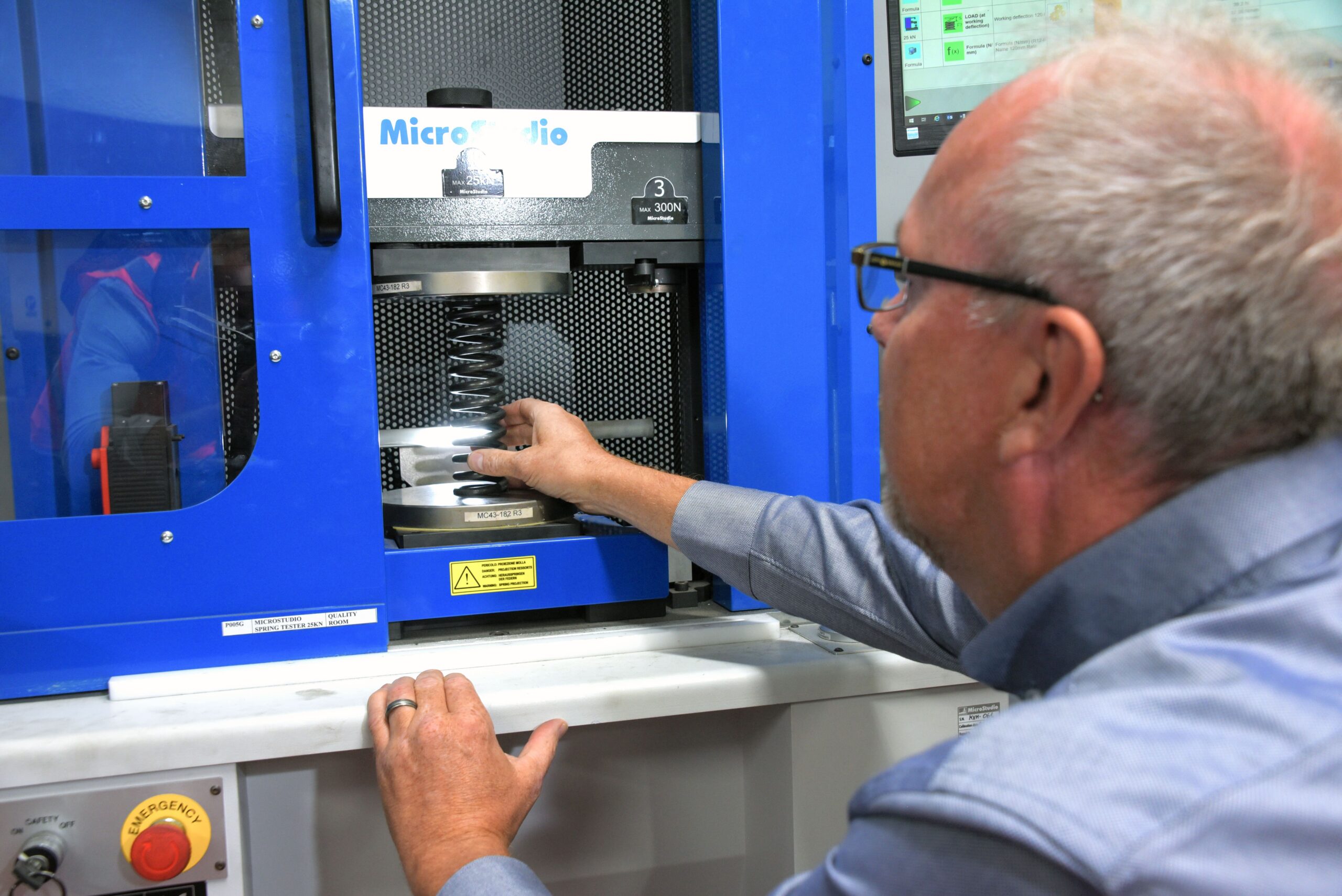
Springs are tested under controlled cyclic loading to measure improvements in fatigue resistance. The resulting cycle life data reflects real-world performance, helping engineers validate designs and compare different treatment options.
Surface integrity checks
Surface roughness, microcrack detection, and hardness measurements are carried out to verify treatment quality. These checks confirm that the peened surface is strengthened and free from defects that could affect long-term durability.
Real-world examples of shot peening improvements
Shot peening is used across industries where reliability, safety, and predictable fatigue performance are essential. Here are some real-world applications where the process delivers measurable gains:
Automotive suspension springs
For suspension components exposed to variable road conditions, shot peening significantly increases fatigue life. Treated springs maintain durability under continuous vibration and loading, contributing to improved safety and reduced maintenance.
One example from our own work involved developing hard-wearing suspension springs to manage the increased payload demands of modern pick-up trucks. Alongside high-quality materials and precise heat treatment, shot peening was applied to improve fatigue resistance and long-term performance
Aerospace actuation springs
Aerospace springs require strict performance consistency. Shot peening helps ensure that actuation systems perform reliably under fluctuating loads, temperature changes, and long service intervals.
Heavy machinery and industrial springs
Industrial machinery often operates under heavy loads and long duty cycles. Shot peening reduces the risk of fatigue failures, helping operators minimize downtime and maintenance costs.
When shot peening delivers the best results
Certain materials, component designs, and applications benefit most from shot peening.
Suitable spring materials
Shot peening is highly effective on materials such as carbon steels, alloy steels, chrome-silicon, and chrome-vanadium spring steels. These materials respond well due to their inherent hardness, strength, and ability to retain compressive stresses. Recent research demonstrates that even aluminum alloys can show significant gains in fatigue strength when properly peened.
Applications with high cyclic stress
Any application involving high cyclic loads or long operating cycles can achieve measurable improvements from shot peening. Industries commonly include:
Automotive suspension
Aerospace actuation systems
Heavy machinery
Industrial equipment
Energy sector components
Shot peening in modern spring design and engineering
Shot peening remains one of the most effective ways to improve spring fatigue performance. By enhancing surface integrity and introducing beneficial compressive stress, it helps springs withstand demanding loads, harsh environments, and long-term cyclic operation. For engineering teams looking to increase fatigue strength, reduce failures, and extend service life, shot peening offers proven and highly reliable results.
At Lesjöfors, we offer a comprehensive range of manufacturing technologies and surface treatments. Our capabilities include shot peening, precision heat treatment, advanced hot and cold coiling, and surface coatings, all tailored to meet the toughest demands in aerospace, automotive, defense, and other high-performance industries.
Contact us to discuss your spring requirements and learn how our technologies can support your next project.
It introduces residual compressive stress into the surface layer, improving durability and delaying crack initiation under cyclic loading.
Improvements vary by material, geometry, and process parameters, but many springs achieve substantial increases in fatigue strength and overall cyc
Automotive, aerospace, defense, heavy machinery, and energy sectors all use shot-peened springs where high reliability and long service life are essential.
Quality is verified through residual stress measurement, X-ray diffraction, surface integrity checks, and controlled fatigue testing.
Most high-load or high-cycle springs see significant gains, but the level of improvement depends on material selection, design, and application requirements.